
Hazelnut
History of Hazelnut
Hazelnut fruit has been consumed relishingly since ancient times. Occasionally having crowned the emperor’s table, hazelnut fruit has later become an epitome of wealth and abundance thanks to the boosting and expansion of commerce in the Mediterranean Region.
Cultivable all around the world and highly sought, hazelnut has been a means of living for many families with small businesses dealing with agriculture. Later through expansion of cultivation areas, it has become an important item of export and import.
Hazelnut has been embedded in the lives of people so deeply that its name is cited in literature, folklore, dictionaries, travel books and even medicine from past to today. Hence, hazelnut has been an essential food of humanity.
Written by using various resources, this thesis attempts at providing comprehensive information about historical development of hazelnut, its species and production areas in the world. It aims at presenting the past and riches of the hazelnut.

Introduction
Having a significant place in our country in terms of protection of economic, social and natural resources, hazelnut plant is classified in (spermatophyta = phanerogamae), subphylum of (Angiospermae), tribe of (Dicotyledonae), sub-tribe of (Choripetalae), group of shelled, order of Fagales, family of Betulacea, species of Corylus.

It is known fact that hazelnut is found in wild forms across the mild temperature zone of Northern Hemisphere from Japan, China, Manchuria, Caucasia, through Turkey, Europe and up to North America. The most important species which make up the culture forms are found abundantly in North Anatolian Mounts and North Pass zones stretching from Artvin to Kırklareli. It was 2500 years ago when hazelnut first became a part of our culture. Around 400 B.C., Enophen mentions about a small fruit, Pontus Fruit, as he calls in Pontus Euxinus (today, Giresun) in North Anatolia. On the basis of this ancient cultural trace, it is widely accepted that the motherland of the hazelnut is Black Sea Region of our country and from there hazelnut spread out to world. This fruit has been a commercial good for 600 years. There are 16 types of hazelnut cultivated in our country.
In addition, as a result of the selection and hybridization works of Giresun-based Hazelnut Research Institute carried out for 30 years, a further 7 types of candidate have been developed, which can be produced commercially.
Cultivated hazelnut had been taken from North Anatolia, first to Greece, then to Italia, where it started to be produced widely around city of Avella, after which Corylus Avellana L., an important species, is named. It was introduced into Sicily and Spain via Arabians, very commonly found in France, where it was embraced as an important cultigen. In UK and German, the types which mainly comprised of Corylus Maxima Mill and selected among natural flora draw considerable interest. In the US, hazelnut farming has been sprawling out in the recent 70 years, made a significant leap backed up by strong research and development programs.
Hazelnut in World Languages
The word “Fındık” is not Turkish word, while terms like “Bundukdar” was embedded in our older language.
Below is a summary of the linguistical information about the etymology of the word “hazelnut” compiled from world dictionaries.
In Greek, Pontikon Karyon is used for halzenut, which means “Pontus nut”. In romaic, Leptokarion (fine nut) means hazelnut in folksay. In Armenian, Kalin and in Albanian, Lajhthi is used.
In Botanic, termed as Corlyus Avellane Pontika, hazelnut, is adopted by Iranian as Funduk and Arabian as Bunduk, also Elculuz is used in Arabian language. In Chinese, it is Chen-tse or Chen-li, its scientific name is Corlyus heterophylla, Fisch.
In Turks outside the Turkey, it is expressed with words that are derived from the root “çit” which is phonetically imitated, another name given by Turks to the fındık.
Kazan – Çitlevük
Crimea – Çetleük
Kumuk – Çertlevük
Fındık also named as Çitlembik in Turkey Turkish
The words used in Main European Languages:
Relative roots in Indo-European Language Group: Qos(e)lo (hazelnut fruit); Lazd (hazelnut sapling)
In Germens; old Nordic: Hasl
Sweden, Norwegian: Hassel
Old Higher German: Hasal
German: Hassel, Hasselnuss
Anglosaxon: Haesel
English: Hazel, Hazelnut
Dutch: Hazelaar
American: Filberts
Latin Languages:
Latin: Corulus, Corylus
Old French: Avelaine
French (small nut): Noisette
Italian: Nucciola
Spanish: Avellana
Portuguese: Avella
Romanian: Aluna
In Southwestern Europe, the hazelnut was cultivated in city of Abella, Campagnola region, Italy, where, therefore, this fruit was called as Nux abellana, which means fruit of Abella, later called as Avellana.
In Slavs: Expressed with les, the joint root, meaning forest.
In Russian (fruit of forest): Liesnoy oreh
In Polonaisen: Leszczyna
In Czech: Liska
Serbian – Croatian: Leska
Bulgarian: Leşnik
In Baltic:
Old Prussian: Laxde
In Lithuanian: Lazd’a
Polish: Lagzds
Finnish: Pahkina
Hungarian: Mogyoro
Author: Governor of Giresun
Hazelnut and Health
Hazelnut has an important place among the dried fruits for human diet and health in featuring a special combination of fatty oil (mostly oleic acid), protein, carbohydrate, vitamins (vitamin E), minerals, diabetic fibers, phytosterol (beta-sitosterol) and antioxidant phenolic.
Nutritive and sensational properties of hazelnut make it a unique and ideal material for food products. Since they contain fat at 60,5%, making hazelnuts a good energy source.
Many researchers asserted that consumption of hazelnut has a positive effect on the human health. These effects may be related with fatty acid profile of hazelnut lipids which is rich in mono- and poly- unsaturated fatty acid (82,8% oleic and 8.9% linoleic).
As demonstrated by the studies, the dietary regime which is low in saturated fatty acids and high in mono-unsaturated fatty acids (MUFA) is effective under the control of level of blood lipids; a similar result, it may be a positive effect on the risk of coronary hearth disease (CHD). Also, the dietary regimes enriched with MUFA (as contained in hazelnut oil at the high levels) creates positive impacts on humans such as lessened CHD cases, hypotension, lowered total cholesterol balance, lowered lipoprotein levels (LDL) or reduced values of blood triglyceride.
In terms of Vitamin E, hazelnut is the best second source after vegetable oils. Vitamin E is a soluble lipid phenolic antioxidant. The antioxidant actions of phenolics come from its ability to convert hydrogen atoms into individual roots. Since these compounds can create individual roots, they are believed to have a potential in preventing cancer and atherosclerosis in patients suffering from diabetes. Due to the antioxidant role of Vitamin E and its relationship with coronary heart disease and cancer, the popularity of natural food products which also include hazelnut and hazelnut products has been growing among consumers and industry.
It is known fact that hazelnut is found in wild forms across the mild temperature zone of Northern Hemisphere from Japan, China, Manchuria, Caucasia, through Turkey, Europe and up to North America. The most important species which make up the culture forms are found abundantly in North Anatolian Mounts and North Pass zones stretching from Artvin to Kırklareli. It was 2500 years ago when hazelnut first became a part of our culture. Around 400 B.C., Enophen mentions about a small fruit, Pontus Fruit, as he calls in Pontus Euxinus (today, Giresun) in North Anatolia. On the basis of this ancient cultural trace, it is widely accepted that the motherland of the hazelnut is Black Sea Region of our country and from there hazelnut spread out to world. This fruit has been a commercial good for 600 years. There are 16 types of hazelnut cultivated in our country.
Hazelnut also contains all necessary amino acids as well as minerals. Hazelnut can also be used as a protein source together with pulse-origin foods which is low in cysteine and methionine. As stated above, hazelnut is a good source in terms of natural antioxidants. This indicates nutraceutical potential of hazelnut and hazelnut products. Consequently, hazelnut is a vital nutrition and ingredient for a balanced daily diet and the most beneficial nutraceutical substance in terms of health of heart. Eating a handful of hazelnut daily may protect you against many diseases as stated above.
Energy and Nutrition Facts
Energy and Nutrition Facts for Roasted Hazelnut Kernels
Energy and Nutrition Facts for Natural Hazelnut Kernels
Storage and Shelf Life
Storing hazelnut in a dry, cool and clean environment will prolong the shelf life of the hazelnut. Keeping it away direct light and storing it in a moisture of 60-65% will prevent unsaturated oil contained in the product from becoming active, eventually avoiding hazelnut from ruining. While moisture increase the sugar rate, it accelerates the oxidation, aggravating microbiological problems and ruining the taste. Thanks to its high fat ratio, hazelnut easily absorbs the odor of the other products such as vegetables, garlic, spices and coffee. Make sure that the places where you store hazelnut are free of any other strong odors, particularly in big packs without nylon wrapping. Since deaerated, air-tight or low air permeable packs have less contact with oxygen and eliminates the potential pest invasion, it will conserve the sense of freshness for a long period prolonging the shelf life.
Shelf-life of finished products is about how sensitive the production and storage is. Shelf-life gets shortened due to the rancidity generated as a result of existence of the free fatty acid or exposure to light, heat or moisture. Rancidity causes undesired taste or odor. Hazelnut resists the oxidation and rancidity thanks to lower moisture levels and high levels of Vitamin E. Lower water action level and moisture rate of hazelnut contributes in its resistance against bacteria and stability of viscosity.
Hazelnut Statistics
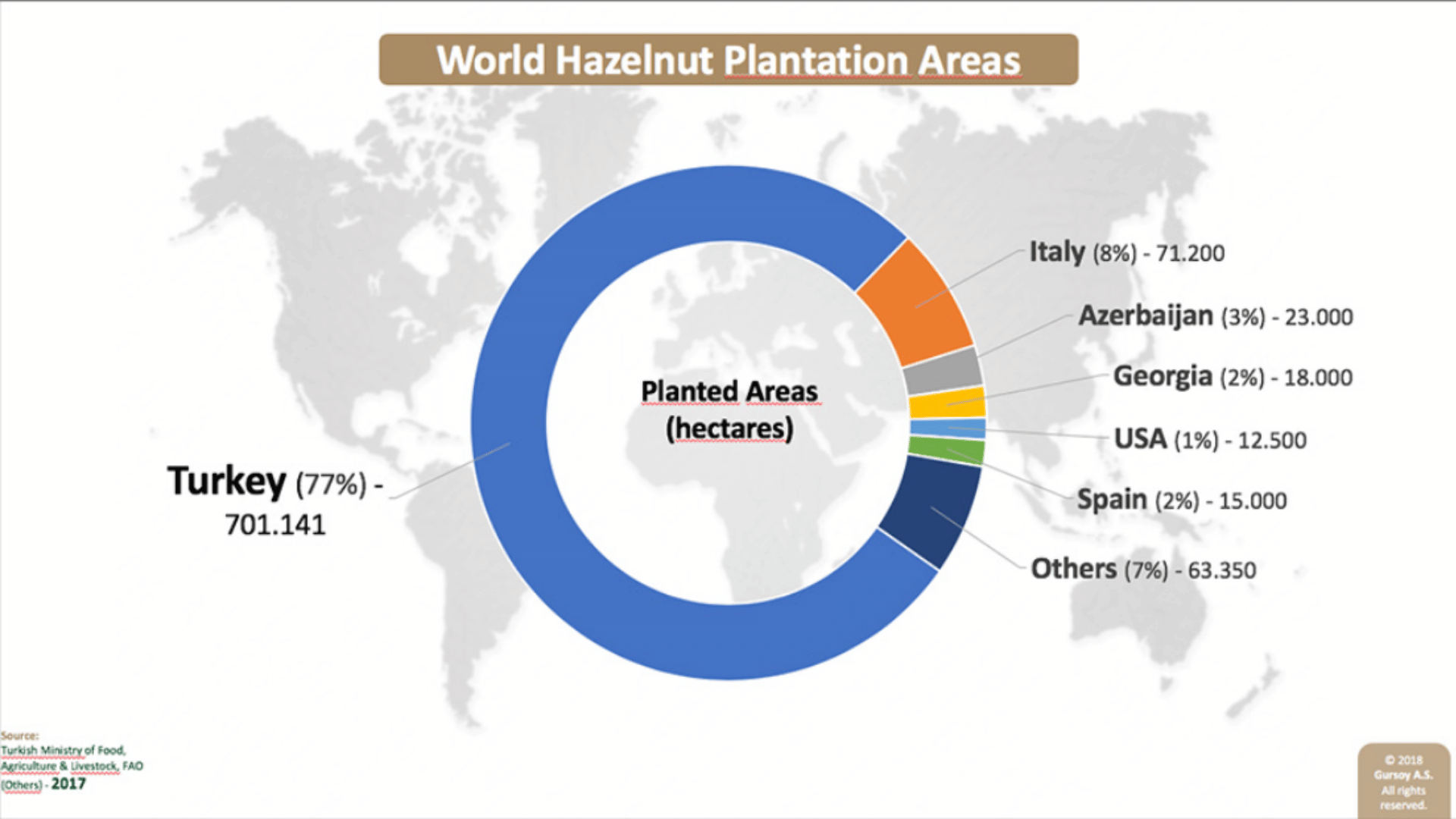
World Hazelnut Plantation Areas
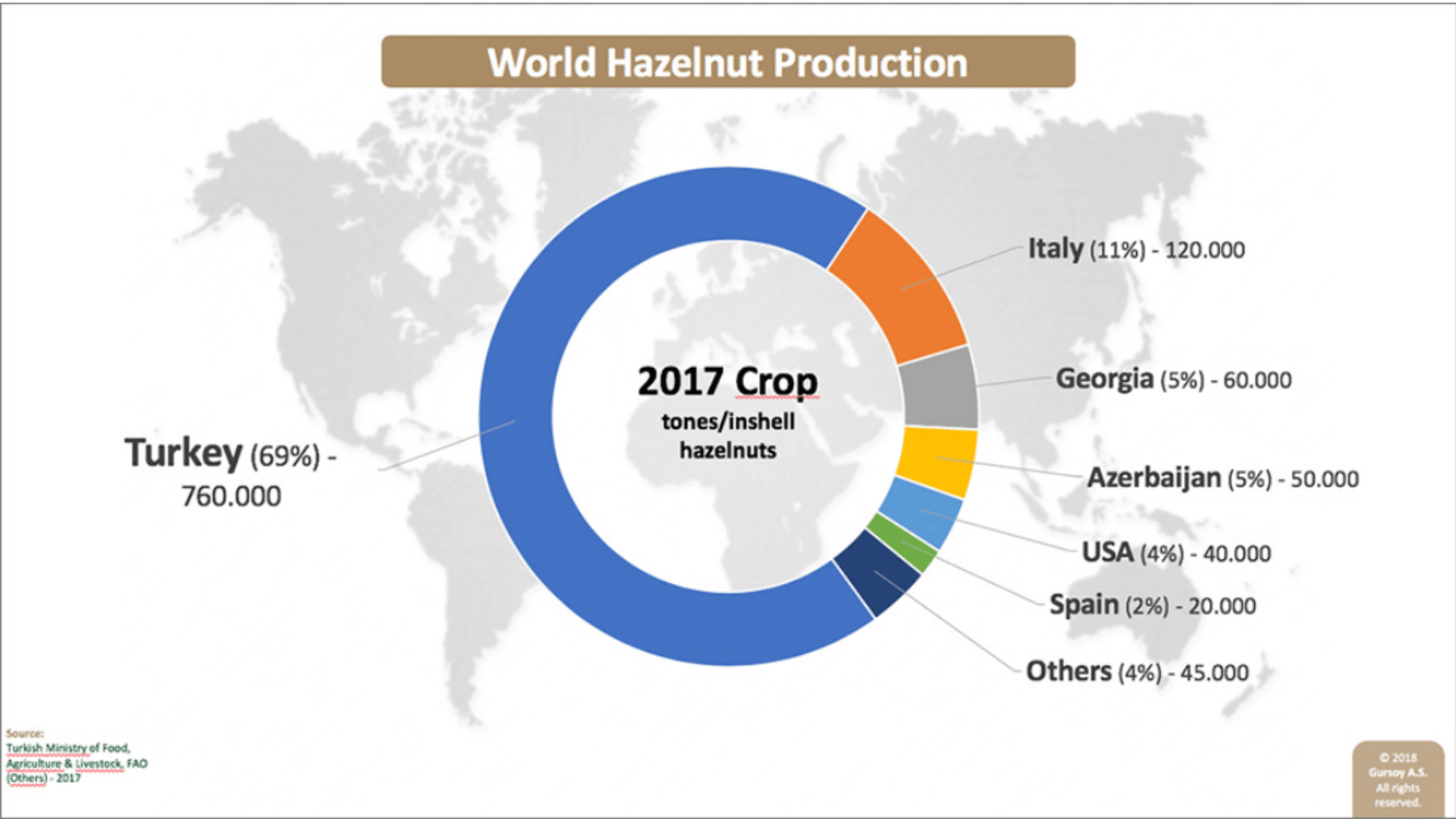
World Hazelnut Production
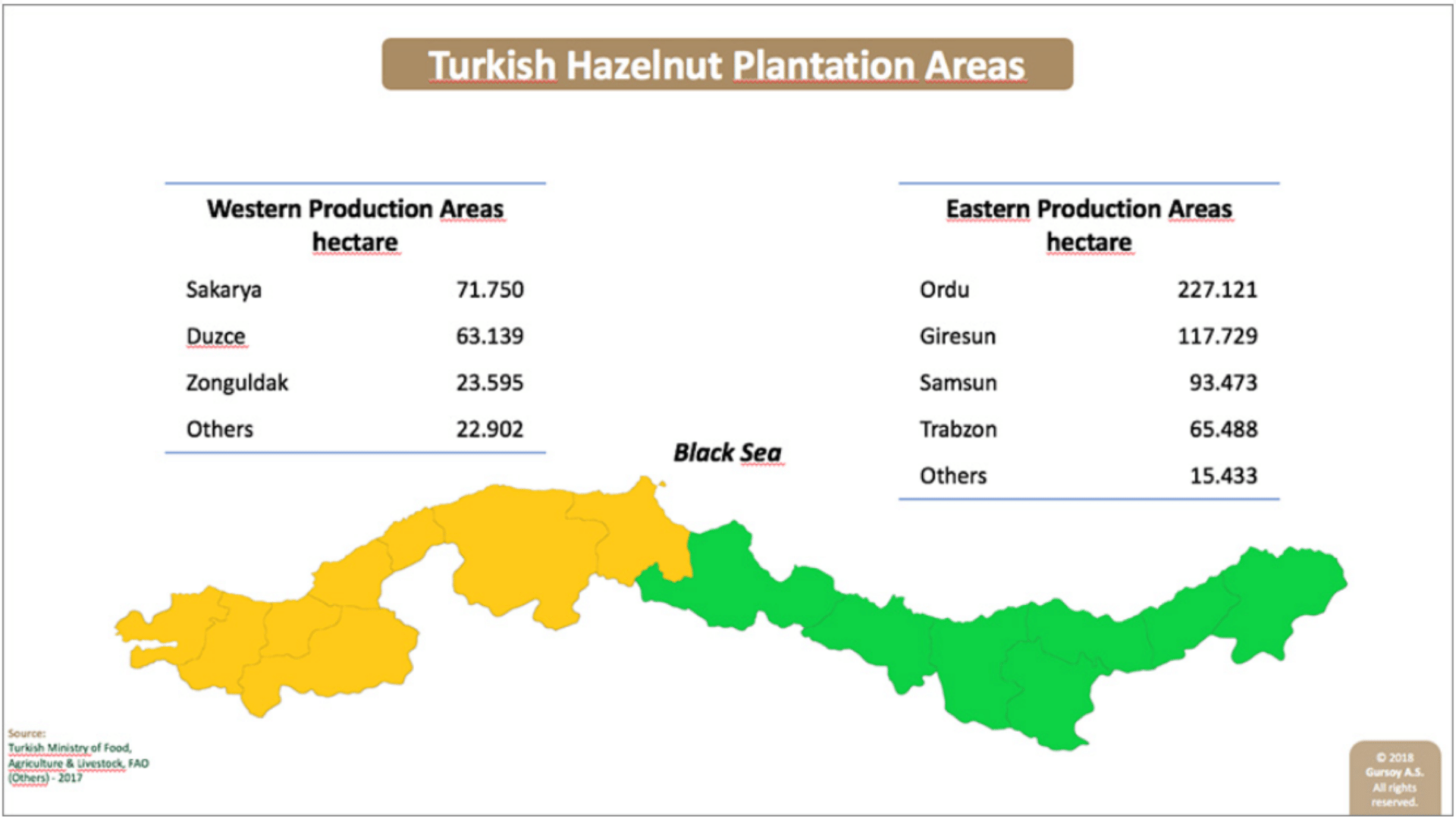
Turkish Hazelnut Plantation Areas
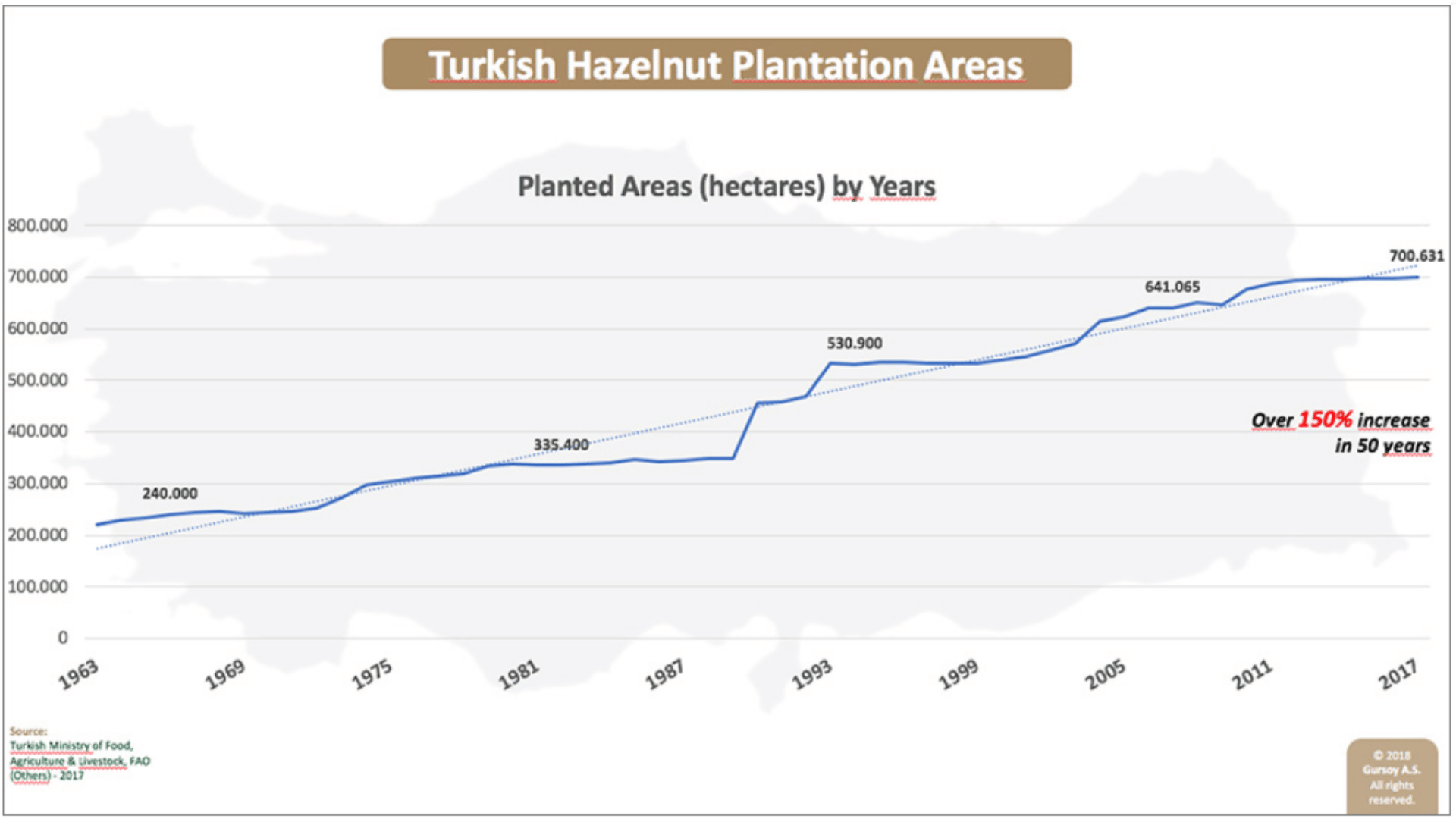
Turkish Hazelnut Plantation Areas by Years
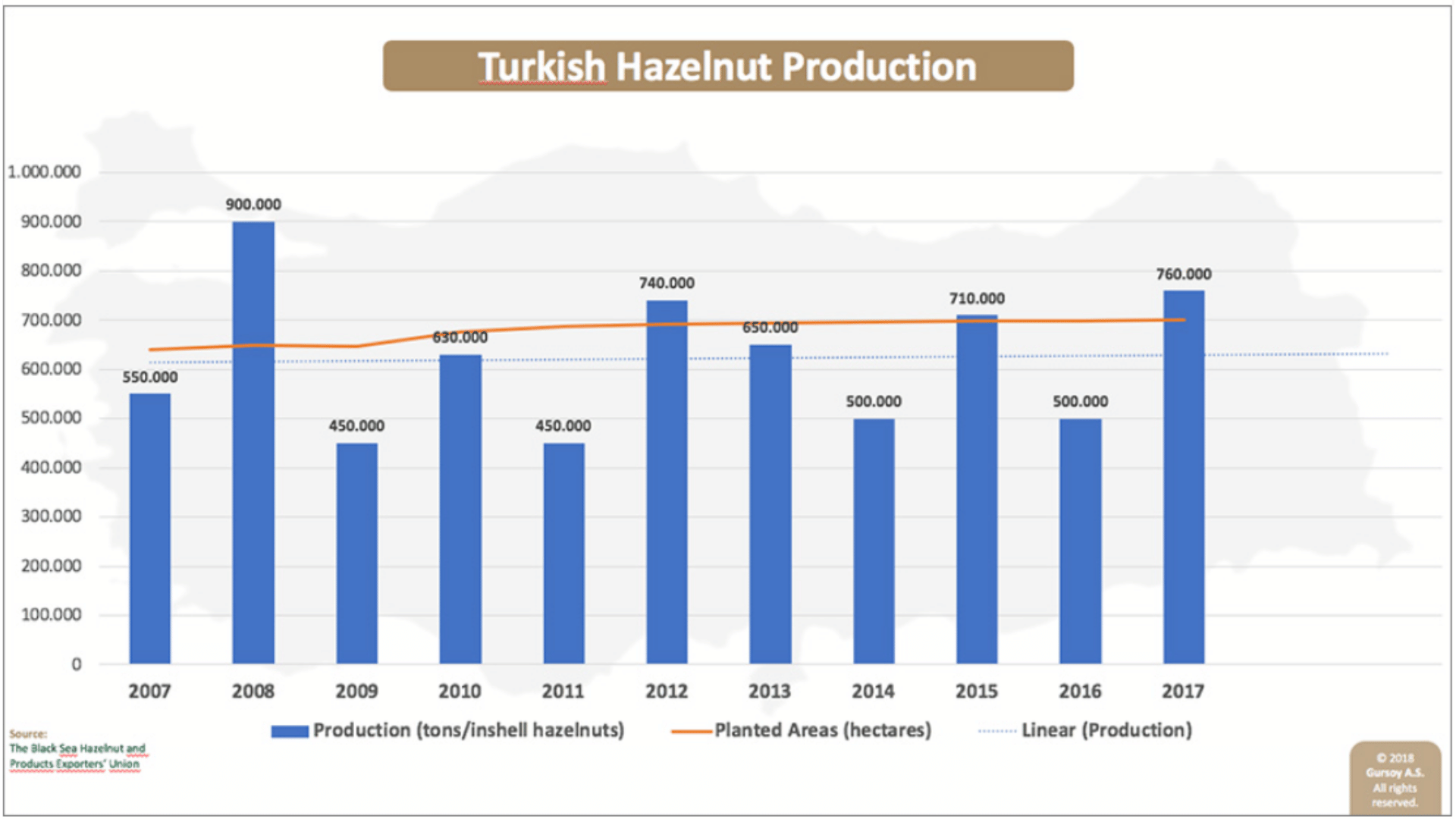
Turkish Hazelnut Production
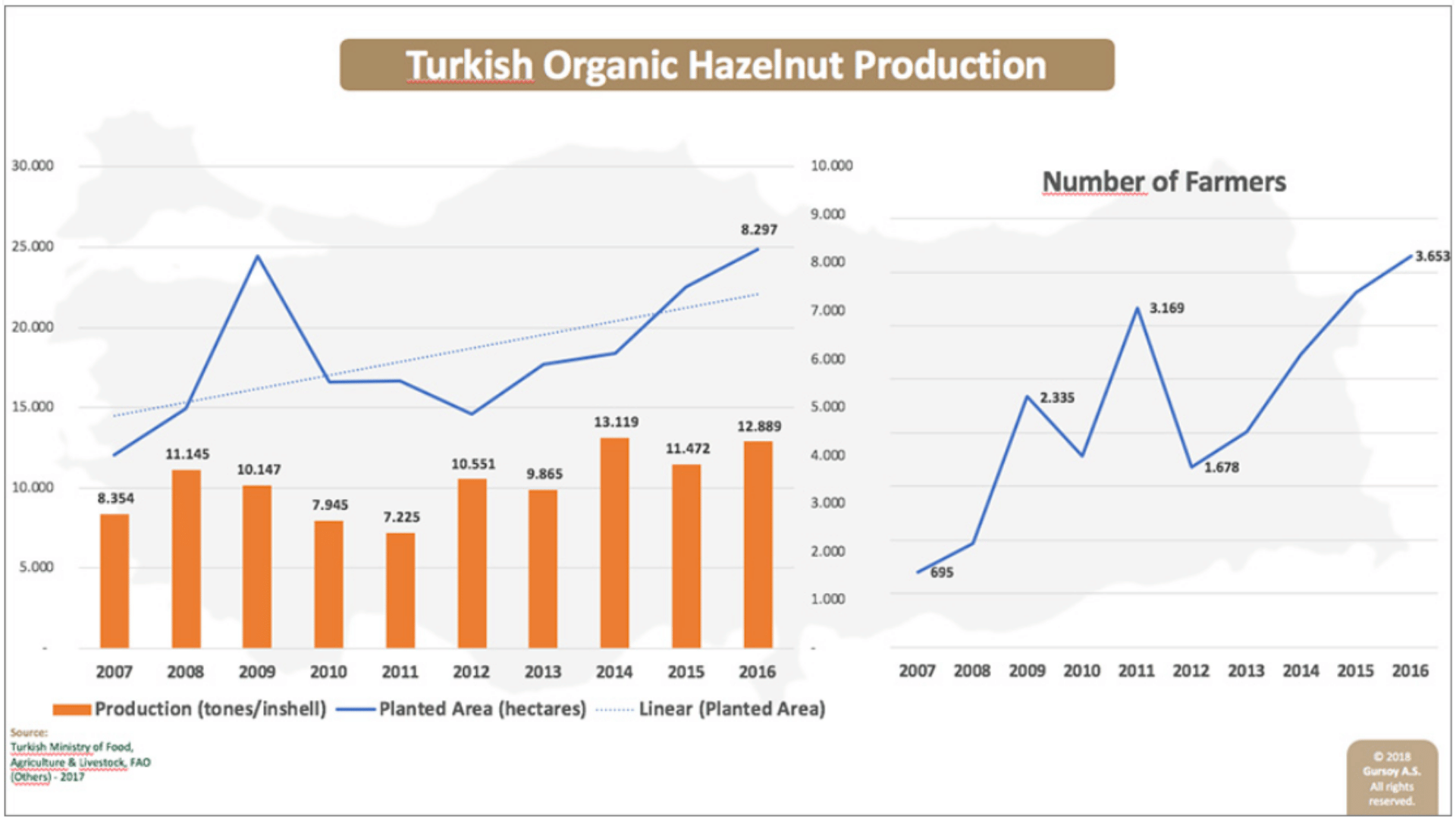
Turkish Organic Hazelnut Production
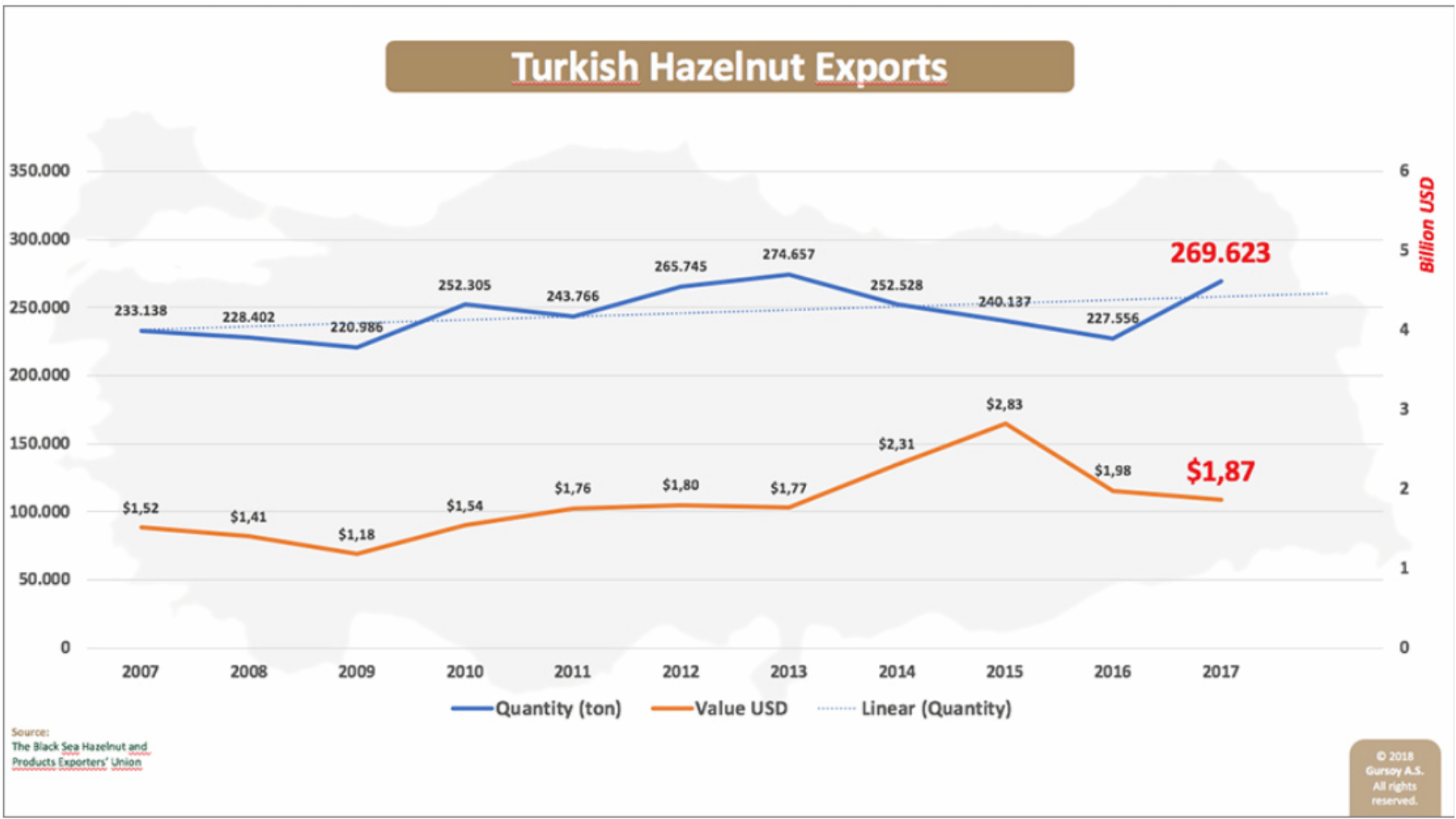
Turkish Hazelnut Exports (1)
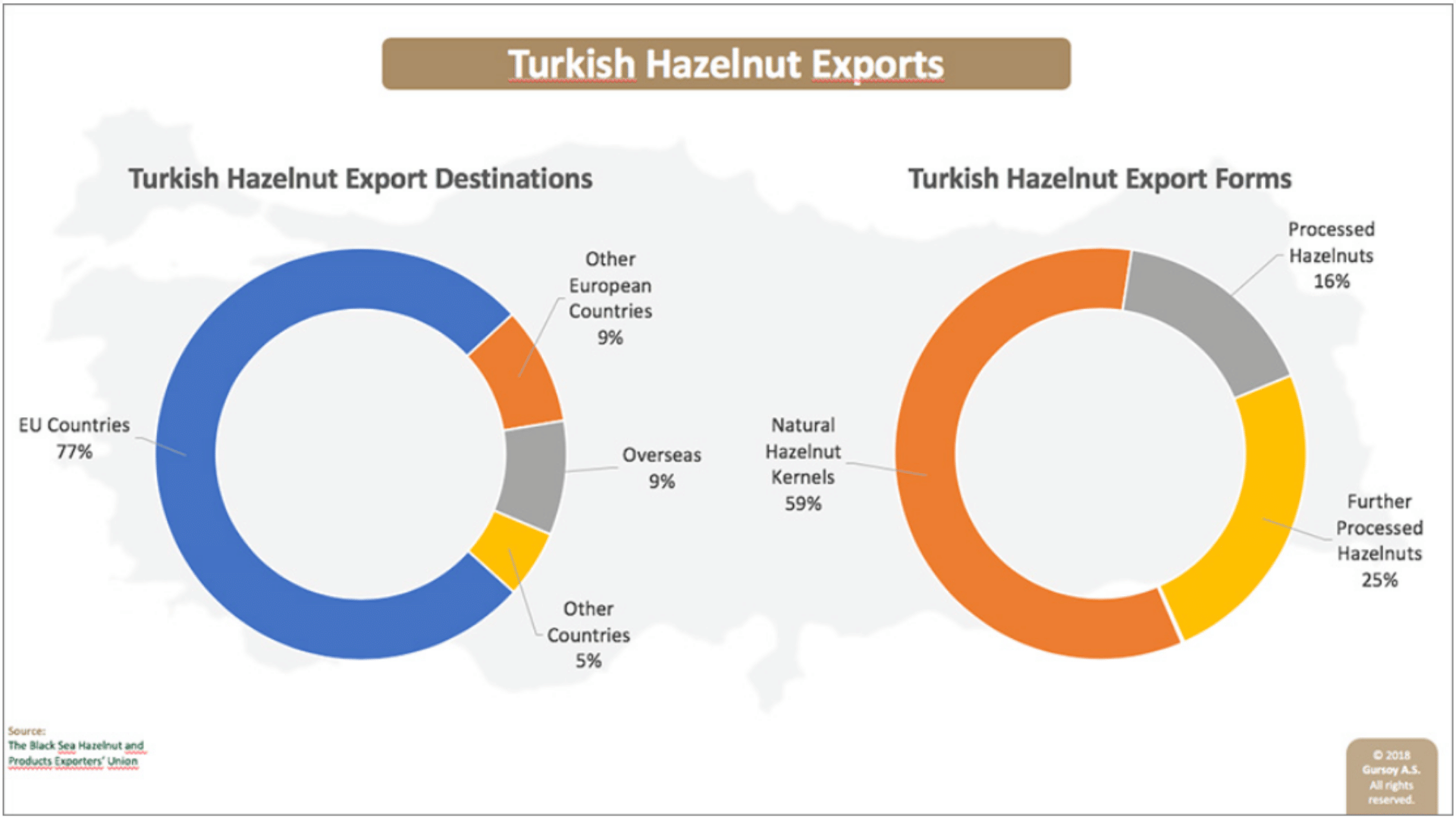
Turkish Hazelnut Exports (2)
Hazelnut Farming
Having produced in Turkey for a long time, Hazelnut is still a conventional export product and contributes greatly in national economy.
Although we are ranked first among countries which produce hazelnut in terms of field, production and export, we are behind the other countries in terms of yield per unit area. Despite it fluctuates from year to year, hazelnut production increases due to the production areas which has been expanding in an uncontrolled manner.
Hazelnut is consumed as a snack as well as has a broad application area in pastry and confectionary industry. Hazelnut has many problems in its production and marketing. The main problem of the production is the yield loss. Hazelnut gardens being old and dense planting, lack of pollinator, deficiencies in technical applications such as pruning, fertilization and fighting are the most important causes resulting in the yield loss. At the top of the marketing problems is the inability to export the hazelnut in the year it is cultivated and accordingly the accumulated stocks year by year.
1. Important Hazelnut Species Cultivated In Turkey
The hazelnut species cultivated in our Turkey is categorized under 3 groups as per their fruit shapes and properties.
2. Climate and Soil Requirements
2.1. Climate Requirements
Hazelnut requires a mild climate to grow well and provide a bountiful harvest. Coastal Zone of Black Sea has the most optimum climate conditions for hazelnut farming. Although it is possible to farm hazelnut in semi-humid and arid climate, lack of necessary rainfall strictly requires irrigation.
In Black Sea Region, it is economically possible to grow hazelnut 60km away the coast towards inland and up to 750m altitude. In regions where annual average temperature is 13-16°C, hazelnut finds its best conditions to grow. Furthermore, in these regions, the lowest temperature must not be less than -8, -10°C, the highest temperature must not be higher than 36-37°C, annual rainfall must be above 700 mm and rainfall must be distributed evenly across months. In addition, the humidity rate in June and July must not decrease below 60%.
2.2 Soil Requirements
Hazelnut is a crop plant with hairy roots, which do not go deeper into the soil, reaching up to 80cm depths of the soil in sloping terrains. While it is not too picky when it comes the soil requirements, it grows best in loamy-vegetal and deep soils rich in nutrition.
3. Hazelnut Farming Method
3.1 Preparation of Terrain and Soil
Having a very long economic life, preparation of land and soil must be done very carefully before planting it. While it is possible to set up a hazelnut garden on the terrains which suit to the cultivation of annual plants, it is also possible to set up a hazelnut garden on the terrains where perennial plants can be cultivated or by renovating the old and aged hazelnut gardens.

3.1.1. Soil-Water Preservation Precautions in Flat Terrains:
For a brand-new hazelnut garden, it is easier to level the soil in flat terrains than sloping terrains, however some different methods are applied depending on the ceiling water being lower or higher.
3.1.2. Soil-Water Preservation Precautions in Sloping Terrains:
In terrains with a slope of more than 5%, a regular planting requires terrain terracing in order to facilitate the storage of rainwaters, prevention of fertilizer wash-out, easier harvest, fertilization and pesticide applications. One of the following terracing systems are used depending on the slope level of the terrain.
- 1. Channel Terraces: When terrain slopes between 5% and 25%
- 2. Trench Terraces: When terrain slopes between 25% and 47%
- 3. Pocket Terraces: When terrain slopes more than %75 and other terrace systems are impossible.
3.1.2. Soil-Water Preservation Precautions in Sloping Terrains:
Following terrain preparation as above, it is necessary to make a good soil preparation before proceeding to planting. Following applications must be made:
– Soil Analysis: After soil preparation, before proceeding to planting, it is strictly necessary to analyze the soil in order for basic fertilization which will provide the soil the nutrients it needs, acidity level of the soil and determination of the lime to be used.
– Subsoiling: Means deeply working into the soil. With subsoiling, subsoil got loosen to allow aeration, microorganism activities are increased, water retention capacity also expands, as a result, physical and chemical structure of the soil is relatively rehabilitated.
– Remedying Soil Fatigue: If the terrain to be used for hazelnut garden has been used for perennial plants for long years, then it means that a soil fatigue is developed. These soils must be left rest in order to remedy the soil fatigue.
3.2. Selection of Type
In setting up a hazelnut garden, one of the most important issues is the selection of type. The types to be used in the garden
- must be fertile and high quality
- They must be highly sought and high priced ones.
- Type standardization must be observed in the garden.
- Also pollinating types must be planted in the garden in order to ensure a high level of fruit set for main types.
3.3. Selection of Sapling and Preparation to Planting
Hazelnut is a plant which develops stool. These stools are used subject to certain rules. Stools which fit for purpose must have following properties:
- Beds must receive ripe, disease-free, 1-2 aged stools, exposed to sun.
- They must have stools with well developed buds.
- There must be stools which have a good root development and develop at points not closer to the bed.
After selecting stools which have said properties, they must be removed with a hoe without damaging the roots. From these stools, “Pruning to Plant” must be done before proceeding to planting. To do so, inured, bruised and damaged roots must cut away by the point of the healthy tissues, long roots must be shortened. Saplings must be pruned to have a length of 35-40 cm with a sharp shears over an bud without leaving a part in the opposite direction of the bud. So prepared saplings must be planted immediately in the pits which were prepared before.
3.4. Planting and Nurturing Systems
The high time for planting is during autumn. Hazelnut cultivation is generally done according to branch planting system. This system is conventionally used in the hazelnut plantations. There are two widely-used planting systems. These are:
- Vertical Planting System: While this system can be used in the flat terrains, it becomes rather important for the sloping terrains with shallow soil. For sloppy terrains, terracing is applied with a top terrace width of 1.5-2m and inter-terrace clearance of 3.5-5m depending on the sloppiness of the terrain. For flat terrains, the clearance between lines must be 4-5m.
- Branch Planting System: This system which rather fits to flat terrains must be applied after terracing depending on the sloppiness of the terrain for sloping terrains. In this system, planting pits with 120 cm diameter and 60 cm depth must be prepared no later than one month before planting.
3.5. Pruning Method
Starting with the shaping the saplings, pruning is one of the important cultural applications which has positive contributions in ensuring annual stool development until the end of the economic yield period, improving the efficiency an prolonging the economic life. With pruning,
- shaping of saplings and retention of this shape is ensured.
- As a result, many long stools are created every year, achieving abundant and quality products.
- Intertwining of the excessively grown branches is avoided, thereby facilitating the agricultural fight and harvesting
- By removing away the unhealthy, old, dried branches and twigs, including those leaning inside the bed, the beds will have a flat crown.
- Also removal of the foreign trees in the plantation will avoid reduced yields that may occur due to the shading.
- Since hazelnut plant inherently has a higher tendency to create stool, stools must be pruned every year to prevent them from excessively consuming the nutrients.
3.6. Pruning Time
In general pruning is done during Autumn. Pruning must be initiated when vegetation stops and leaves are substantially shed.
The tools used for pruning:
- Pruning Saw
- Pruning Shears
- Gardener’s Hoe
3.6.1. Pruning Method in Hazelnut Plantations Shaped As per Nurturing System.
In the first five years, saplings which got their shapes as per nurturing system applied enters in the yield period and this productivity reaches up to maximum level after 12 years. This high level of yield generally continues up to 20-25 ages. During this yield period, dried, broken, injured, unhealthy, intertwined branches as well as all other stools and annual stools which transgressed the shape given, are cut away with a pruning shears every year in Autumn. After 20-25 ages, twigs on the side braches becomes denser and as annual stool length got shortened, the yield starts dropping.
In this period where yield starts dropping and physiological balance gets deteriorated, a rarefaction is applied on the annual stools shorter than 10 cm and twigs on the side branches in order to increase the amount of annual stool and length, provided that the shape given is preserved as much as practical. By shortening the stools which overflew into the branch or outside the crown, vegetative and generative development is facilitated. Therefore, annual pruning works are applied progressively denser so that deteriorated physiological balance will be restored.
3.6.1. Pruning Method in Hazelnut Plantations Shaped As per Nurturing System.
Plantations show random branching since they are not set up according to planting and nurturing system by using a suitable method. In such plantations, no regular yield is achieved also since no pruning is applied. Such plantations;
- are planted very dense and aged.
- The number of main branches in the bed is excessive.
- Since the clearance between main braches is made very short during planting, it shows branching in just one point, roots develop intertwiningly and branch at height and branches are intertwined.
- Inside the bed are enclosed, so aeration and sunbathing is not sufficient.
- The development of main branches in the bed is irregular and braches have age differences between them and branches and twigs get broken due to the friction between branches during harvest and buds must be emptied.
- Unhealthy, dried, aged branches as well as base stools are cut away at higher levels, since harvesting done with stools left on the main roots for long years, roots has become thick and dysfunctional.
In such gardens, before proceeding to the pruning, some beds must be removed in order to enlarge the clearance between beds. The target must be to reduce the number of main branches in a bed to 6-8 and aged, drying, unhealthy branches and the one of those intertwined branches must be removed with a pruning saw at its bottom and applied with grafting wax at the removed points, while leaving branches developing towards sides untouched. By developing stools in the gaps of beds, the empty sections of the stool are filled and cleaned. Main branches left in the bed untouched are examined one by one and those intertwined, unhealthy, dried and injured branches and twigs are sheared without leaving any parts. All other stools developing into the bed are removed, the stools overflowing the sides excessively are pruned at the top. On side branches, alternating, long and strongly developing stools are left untouched. Weakly developed stools are sheared and rarefied. Thus, with fertilization, efforts are made to restore the deteriorated physiological balance.
If there are thickened roots, “karacakarta” in majority of the main braches, weakened stool development and denudation of branches, then it is very difficult to restore the physiological balance with pruning and fertilization.
3.6.1. Pruning Method in Hazelnut Plantations Shaped As per Nurturing System.
Hazelnut has a higher tendency to develop stool. They develop abundantly on the roots of main branches every year. These stools becomes a partner of the nutrients of the bed, causing branches become denser and preventing aeration and sunbathing. On these reasons, by keeping the number of main branch planted fixed during the production, these stools must be cleaned with a gardner’s hoe at least two times a year, one being in the autumn and the other at the beginning of June or at the end of May. However, if the dried, broken, unhealthy and aged branches are removed during production time, one of the stools growing in the direction of the branch removed is left untouched to develop. Thus, the place of removed branches in the bed is filled.
3.7. Fertilization
Fertilization is of outmost importance in hazelnut farming in order to have a healthy development of hazelnut saplings following the planting and to have a quality product even after the nurturing period.
3.6.1. Pruning Method in Hazelnut Plantations Shaped As per Nurturing System.
Achieving the expected benefit from fertilization is only possible with determination of deficient nutrients in the soil and the level of the deficiency. In new gardens or those in the nurturing period, soil and leaf analyses must strictly be carried out in order to determine the nutrients needed by hazelnut to undergo a normal development.
Fertilization in New Hazelnut Gardens (0-5 ages): In order to enrich the soil in organic material, farm manure of 3-5 ton per decare and lime in recommended amounts per soil analysis results must be distributed homogenously all over the land surface and deeply hoed before proceeding to digging the sapling pits. Also, as the basic fertilization, a mix of phosphorus and potassium fertilizers in recommended types and amount must be applied to the sapling pits before planting.
Following this basic fertilization, from first year to fifth year, half of the 40g Nitrogen fertilizer must evenly be applied at the beginning of March and the other half at the end of May or at the beginning of June around the saplings and then hoed. This fertilization applied as such for the first five years will ensure annual growth of stool having the desired properties.
Fertilization of Hazelnut Gardens in the yield period. It is only possible to have a regular development and abundant product yield with the nutrients it receives from the soil. Most important of these nutrients are nitrogen, phosphor and calcium. Although other nutrients are very important for hazelnut, these are not much important as those said above.
Lime Application in Hazelnut Gardens in the yield period: Hazelnut plant can only undergo a normal development and yield abundantly in the soils with a pH of 5-7. However, soils of Black Sea which is used for hazelnut farming is generally acidic in character. The damages to be caused by the lime deficiency in soil on the hazelnut is directly related with characteristics of the soil nature as well as failure of in-taking other nutrients, revealing itself as premature leaf yellowing, dried top stools, weak root formation, and problems observed during nitrogen, phosphor and potassium deficiency.
Application of lime on acidic soils will restore the physical, chemical and biological properties of the soils. Also aeration, heating and water retention capabilities of the soil improve. Micro-organism activities in the soil increases, and decomposition of some nutrients and washing out of some are prevented, and retained in the soil. Especially, soil which is acidic in character also increases its pH to degree which is required for the hazelnut growth.
In general, November-December is suitable period for lime application. Lime application must be repeated if it is found necessary after the soil analysis conducted one in 4-5 years. Lime is applied by using one of two methods. After sprinkling the lime in the recommended amount evenly and regularly all over the garden, it is hoed as much deeper as possible, paying attention not to damage the roots. Or, after distributing it evenly on a strip in the ring form with a width of 50-60cm branch projection of beds, it is hoed as much as deeper possible into soil. In the latter, the lime amount to be applied will be lower than the former one.
Application of Farm Manure in Gardens in the Yield Period: The farm manure or similar organic fertilizers to be introduced in the soil have positive effects such as increased yield levels of soil, retention of the nutrients by the soil, increased levels of water retention and cation exchange capacity, aeration and workability of the soil, early mellowness of the soil.
In hazelnut gardens, these fertilizers are distributed evenly in the amount of 30-40kg on the ring-shaped 50-60 wide strip on the branch projection of the bed at the beginning of Autumn or Spring and then immediately soil is hoed.
4. Harvesting, Threshing and Storage of Hazelnut
4.1. Harvesting
A general cleaning must be done in the hazelnut gardens before proceeding to harvest. To do so, the garden must thoroughly be cleaned with a special tool so-called “girinti” at least 5-10 days prior to harvesting. It is understood that hazelnuts got matured enough to harvest by looking at some indicators. These are;
- Fully reddened husks
- Hazelnut kernels get easily disintegrated from husk.
- 3/4 reddened hard shell, and seeds with its genuine hardness and taste
- 3/4 of the fruits falling down from the branch when you shake the branches carrying the intact and full fruits.
While the best method to harvest hazelnut is the shaking-off & picking-up method, there are few gardens which will allow such method. In this harvesting method, since the hazelnuts are picked up exactly when they are ready to harvest, the highest yield and quality is ensured as well as it protects the buds against damages, which will produce the crop of the next year. The common method in the region is the picking-up directly from the branch. The most important points in this harvesting method are, not to cause friction between branches, plucking off the husks one by one at the point they join with branch, and not to use as a picking up method the “stripping” in order to preserve branches, twigs and buds which will produce the crop of the next year, and carefully putting the branch back after harvesting.
4.2. Threshing
Hazelnuts collected in the baskets are carried in 30-40kg baskets, locally called as harar, selek or hey, or in sacks on back or via transportation vehicles to the threshing site. In the region, the threshing sites are generally flat or slightly sloping meadow and hard earth.
Hazelnuts delivered to threshing site are stored there in piles for 3-5 days. Then they are laid out in a 10-15 thick layer with a rake over the threshing site. In sunny days, the piles are reshuffled with a wooden shovel or rake every day until it dries for 3-5 days. Having dried to some extent, these hazelnuts are introduced into the hazelnut stripping machine to detach their husks. Stripped hazelnuts are laid in a 2-4 cm layer on a cloth for soil sites, without soil for concrete sites. In sunny days, they are allowed to dry by reshuffling them with a rake for 2-3 times very day. Having dried for 3-4 days, hazelnuts are introduced to the ventilator to remove the dust, soil, husk particles as well as hollows. Having cleaned, hazelnuts are again laid out on the threshing site to pick and remove hard and foreign substances such as stone, soil out.
4.3. Storage
The place to be used for storage must be cool, dry and ventilable. In these conditions, hazelnut can be stored intact for a maximum of 1 year. For storage longer than 1 year, temperature must be at 2-4.5C and relative humidity from 55% to 60%. Heightened temperatures causes to rancidity and increased relative humidity causes the mold growth.
5. Hazelnut Diseases
- Hazelnut Bacterial Burn
6. Hazelnut Pests
- Hazelnut Worm
- Hazelnut Moth
- Hazelnut Acarina
- Anisandrus dispar
- Phoma tracheiphila
- Hazelnut Gal Fly
- Lepidosaphes ulmi
- Hazelnut Brown cochineal
Hazelnut Farming Schedule
January
During this month, female flowers, a.k.a. cloves, starts flourishing on the hazelnut branches. Popping out of a flake-covered bud and boasting fiber-like slim extensions in colors of red, maroon and pink varying by types, these female flowers will each be a hazelnut husk in the future.
If you want to cultivate a high yield, these cloves must be healthy and be inseminated and protected against cold. In this respect, precautions must be taken in these months against the winter frosts and late spring frosts.
For this purpose, easily flammable, smoke or fume releasing brushwood or similar flammable material must be supplied and piled up in the garden in the dominant windward side usually until the end of March. Once a danger of frost appears, they will be set on fire with easily flammable materials such as kerosene to protect hazelnut garden against frost.
Again in this month, before buds out, pesticides are applied to fight with Lepidosaphes ulmi.
In addition, intertwined and dried branches can be gathered up and set on fire to fight with Anisandrus dispar which is especially seen in sandy soils. This application will be repeated in the next months.
February
Female flowers are fully matured, while male flowers starts spreading their pollens out.
Hazelnut gardens starts appearing like covered with a bright yellow tulle, especially on the days where it does not rain and plus gently breezes. This is the sign that yellow pollens will be carried by the winds reaching cloves and starting the impregnation.
The better the weather conditions in this month, the higher amount of the pollen carried reaching the clove and the better the impregnation, meaning that the product will be abundant in that year.
Of course, it is necessary to nurture well the impregnated clovers to have good and abundant product. For this purpose, burnt farm manure must be introduced by this month. Used once a 3-4 years, farm manure must be introduced in the soil by strictly mixing it in the amount of 25-30 kg right under the branches under the beds.
You should remember that one ton of burnt farm manure contains 5.5 kg of nitrogen, 2.5 kg of phosphor, 5,5-6 kg of potassium and some other plant nutrients, and also improves the composition of the soils.
In this month, it also benefits to burn cones by manually picking them up in order to eliminate the acarina causing damages as well as hazelnut moth which has been living inside the cone during winter.
A better fertilization means more products and more yield.
If you use unburnt farm manure, please note that our garden will not benefit from fertilization sufficiently and may be plagued with other plants such as stinger and blackberry.
March
While the ice-cold weather conditions are seen from time to time, March is the month where the weather and soil starts getting warmer and the living beings starts becoming lively.
Now, the nutrients so much needed by the plant, namely, fertilizers must be introduced into the soil. Especially, half of the recommended amount of the nitrous fertilizers are sprinkled directly under the branches, as is in the farm manure, and then mixed in the soil which is hoed in a depth of 5-10cm. But, before introducing the fertilization, soil analyses must be conducted so that you can avoid under- or over-fertilization.
Mixing the fertilizer with soil by hoeing will both make best use of the fertilizer and ensure an effective fight with various pests which has been living in the soil during winter.
The fight against hazelnut acarina which infests the various buds via pesticides must begin by the end of this month in warmer years, and for fresh stools, when the third leaf from the bottom falls over back.
The fight against Anoplus roboris with pesticides starts by the beginning of this months, before its larva opens tunnels.
In this month, precautions must be taken against damages in the gardens with premature foliation due to late frosts in spring.
In the meantime, weeding out the stools and braches which are damaged due to winter conditions must be continued.
While sprinkling the nitrous (summer) fertilizers and farm manures right under the braches 50-60cm away the bottom of beds, it must be hoed ensuring that it thoroughly mixes with soil.
April
Now, hazelnut branches starts producing green leaves, gardens start covered with a lush cloth. Hazelnut husks start heaving into sight by this month.
In general, this is the month where the fight against acarina with pesticide can take place. If there are 30 cone on average per bed and for fresh stools, 3rd leaf from the bottom falls over back, then pesticide application must start immediately. Therefore, a fight with Hazelnut Moth can take place too. Because hazelnut moths lives in the cones during the winter and opens galleries in the fresh developing stools and buds causing them to dry. If pesticide application is repeated 15 days later, the better results will be achieved. Animals must not be allowed in the gardens applied with pesticide for 30 days.
In the recent years, the fight against the matured Palomena prasina which spent the winter in the gardens, an insect known with its damages in the form of amorph kernels with tumor, takes place in the second half of April.
During the early in the morning, 10 beds must be shaken off and if at least 1 mature insect falls down, pesticide must be applied by mixing it with water of 8-10 liter per decare.
If nitrous fertilization is not used yet, it can also be applied in this month. Please note that keeping infant hazelnut on the branch and nurturing it is only in the hand of humans.
The success in agricultural protection is only possible by using the pesticide which is effective on the target pest in recommend dosage and on time.
May
In this month where all living-beings emerged from winter sleep and became active, and hazelnut husks grew large and kernels being formed, the pests of the hazelnut starts giving damages to it. In this respect, a special attention must be paid to the pest control in the May.
The fight against Hazelnut Worm, which is the most common pest infesting the hazelnut, which damage so high that just a pair of it damages around 200 fruits, take place in this month where kernels reached up a size of lentil seed. For this purpose, during early hours in the morning, branches are shaken off on a white cloth of 3×3.5meter and mature Hazelnut Worms are examined. If at least 3 mature pests fall down per 10 beds, pesticide must strictly be applied.

Even tough there is a wide range of pesticides for hazelnut worms; water-soluble pesticides must be used in order to avoid environmental damages, especially birds and bees. Pesticides must be applied such that it will not cross the crown limits of the bedding and it will cover the reverse face of the leaves. Animals must not be allowed in the garden applied with pesticide for three weeks.
The second half of the recommended nitrous fertilizer is applied towards the end of this month as specified for the first half (in March).
In hazelnut gardens, leaf fertilizers containing trace elements, introduced through leaves, are applied for 2-3 times between May and June with a 15-20 days in between and the first application starts towards the end of this month.
No animals must be allowed in the garden applied with pesticides in the specified period and fruits must not strictly be eaten without first thoroughly washing them.
June
In this month, accepted as the start of summer, kernels continued to develop and husks start becoming bigger. Farmer can estimate the yield in that year by looking at the husks developed on the branches, which is the value for his efforts, and starts calculating his earnings.
In the garden, herbicide application against weeds such as stinger, blackberry takes place towards the end of this month.
If the bottom stools in the hazelnut beds have not been cleaned in Autumn, they can also be cleaned in this month.
Pest control with pesticides is proven successful against active 1st period larvae of brown cochineal, which lives on sucking the juice sap of branches weakening the plant and even dries it out. Pesticides must be applied towards the end of June (close to completion of hatching).
Before proceeding to pest control application against this pest, which became extremely widespread, causing frequent complaints of the farmers, you must do a pre-control, by randomly selecting marked 3 infested stools from each 10 beds, namely a total of 30 stools, then if you found 5 alive cochineals in each of them, then you should apply pesticides.
For a successful application, entire leaves, branches and stools must be applied with pesticides.
In this month also fight against Anisandrus dispar with pesticides take place. A tour around garden take place in the half of June in the gardens infested with this pest. Pesticide application must be done if you see fresh wood chips produced by mature female insects which started opening galleries and 15-20 days after the first application, second one must be done.
.
July
In this month where hazelnut producer is full of hope and joy with his eyes focused on the hazelnut branches, the hazelnut is also full of fruit with an hardened shell.
In some years with lower levels of precipitation, drought may occur. In order to prevent hazelnut garden from this adverse conditions leading to unbalanced water in the plant resulting in fruits with immature kernels and increased wastage before the harvest, irrigation must be applied to the gardens as much as practical.
Now, there is little time to harvest the hazelnuts. In gardens, pre-harvest cleaning must be done, tools and equipment must be repaired, shortages must be made up both at home and the threshing site and threshing site must be prepared.
If nymph concentration of Palomena prasina is excessive, pesticide should be applied. For this purpose, nymph pesticide is applied by adding 50 liter water per decare in any of the pesticides specified for April (but a different one is recommended).
In order to have analysis made for using suitable and sufficient fertilizer in the future, a leaf must be sampled in the second half of this month (10-15 days before harvesting). Soil can be sampled at any time before introducing the fertilizer.
Before proceeding to the fertilization, garden soil and/or hazelnut leaf must be analyzed in order to determine the fertilizer depending on the type and requirement determined.
Thus, excessive use of fertilize is avoided and composition of the soil remains intact.
August
In this month where hazelnut is harvested, all gardens become populated and cheerful with people from old to young, from women to men, everyone is occupied with the hazelnut.
It is now time to harvest the labor and efforts of the farmer who has been constantly busy with hazelnut for one year. However, for a farmer to be fully rewarded for his one year of effort, hazelnut must have reached up the full maturity for the best yield. Because, harvesting immature hazelnuts causes lower yield, increased crisp resulting in shortened storage times.
It must be remembered that the pre-determined conditions must be observed to protect quality during plucking-off as well as storage of the hazelnut which are picked up by hands on the grounds after having shaken off the branches, which will eventually contribute in the economy of both farmer and our country.
September
In some sites where threshing time delayed, product must be protected well against the autumn rains.
Necessary precautions must be taken in order to protect hazelnuts against damage, which could not be dried earlier or stayed under the plastic cover for a long time.
After completion of the hazelnut harvest, pesticides must be applied against the hazelnut moth. For this, you should check out if brown spots exist in triangle indents where middle vein joins with side vein on the reverse face of the leaves, if there are problems in more than 15 of the 100 leaves we checked out, then pesticide must be applied.
October
In previous month, hazelnuts were picked up, threshing completed and many farmer has sold them and got rewarded for their efforts of one year.
Now, it is time to boost up or at least maintain the yield of next year. Because, October and November are preparation months for the product of next year.
For this, special attention must be paid to pruning. First, dried, broken or less productive branches and even beds must be removed to replace with new young stools. In the meantime, unnecessary stools must be removed.
On the other hand, the time of introducing the phosphorous and potassium fertilizers, so-called winter fertilizers, is also the October-November. Phosphorous fertilizers which are introduced in general 3 times a year, must be used in 20-30 pits to be dug in a depth of 10-15cm right under the branches around the beds.
Again, the fights against larvae of May insect with pesticides starts in September-October. For this, 16 different points of the garden where problems are seen are marked with a 50x50cm frame, which are then dug in a depth of 25cm and the soil taken on a cloth is examined, if there are 3 pieces of larvae in 1m2 (four frames area), then soil must be applied with pesticides.
November
Regarded as the beginning of winter season, in November, if weather permits, removal and cleaning works are continued in the hazelnut gardens. In the sites where winter (phosphorous) fertilization is delayed, it should be applied in this month.
For hazelnut to develop well and produce a bountiful harvest, the fertile soil must have a pH of 5-7. The recommended lime as a result of the soil and leaf analysis is first sprinkled right under the beds and then introduced in the soil by hoeing it in a depth of 5-10cm.
It is recommended not to introduce the lime and recommended winter fertilizers at the same time.
Pesticides for Lepidosaphes ulmi, which is mainly dealt with in May, can also be applied in this month. On the other hand, while dried branches are removed, fight against Anisandrus dispar also continues.
In the sites with heavy winter rains, farm manure can be introduced from this Month up to March. Please note that the best fertilizer is farm manure and these fertilizers contain every sorts of nutrients, which is necessary for the soil.
Although there is less work in November, hazelnut farmer will stay in the garden to cut firewood and to ensure that his animal in his barn have comfortable conditions.
While introducing fertilizer in the soil, do not just sprinkle and leave them on the bottom of beds.
Desember
It is the month which a hazelnut farmer has the least things to do.
Male flowers on the branches got bigger, buds of cloves got swollen and ready to burst, red tips are sporadically seen.
According to results of soil and leaf analyses, farmer introduces the limes, if weather permits, if he has not yet applied it, and repair fences and trenches.
Our Certificates
